Author: network

  • On Propaganda

    On Propaganda

    Proposal:  On Propaganda – from the past to the present

    Implementation: 2026 TO 2028

    Call: CERV-2025-CITIZENS-REM – European Remembrance – 2025

    Type of Action: CERV-LS – CERV Lump Sum Grants

    Proposed Budget: 253 695,00€

    Keywords: Populism, Democracy, Fake-news, Human rights, Civil society, Extremism, defence of fundamental rights, democracy, and minority rights, resist polarising, discriminatory, hate speech, promote critical thinking and media literacy, combat propaganda

    Objective: The project aims to raise awareness among European citizens about their shared history and the importance of mutual understanding and tolerance particularly in light of the resurgence of far-right ideologies in European politics. It aligns with the priority “Democratic transition, (re-)building and strengthening society based on the rule of law, democracy, and fundamental rights” and involves a consortium of countries with historical and/or present ties to far-right movements.

    This initiative focuses on strengthening European citizens’ awareness of discursive propaganda as a manipulative tool that threatens EU values, fundamental rights, and democratic institutions. The project encompasses various activities, such as the organisation of memory forums, the creation and testing of formal and non-formal education toolkits on media literacy and the elaboration of a policy recommendation on the use of propaganda by modern far-right parties and movements.

    Targeting young people, teachers, universities, NGOs dedicated to capacity building and defence of fundamental rights and democracy, and museums, the project aims to educate the general population and equip them with tools to critically assess information. By analysing narratives and propaganda from World War II to the present, the project aims to empower individuals to resist polarising, discriminatory, and hate speech, thereby defending fundamental rights, democracy, and minority rights. The comprehensive research will cover propaganda used by totalitarian, authoritarian, Nazi, and fascist parties during World War II, as well as contemporary far-right parties. In this sense, the project seeks to promote critical thinking and media literacy amongst the general population of the consortium countries to combat propaganda that weakens EU values and democracy.

    Partners:

    • Young Educators – European Network
    • Archeia Sygchronis Koinonikis Istorias Mi Kerdosk
    • Universidad Rey Juan Carlos
    • Federazione Italiana Diritti Umani Comitato Italia
    • Universidade Do Minho
  • Is Climate Change a Valid Reason for Migration? Evidence from a Conjoint Experiment

    Is Climate Change a Valid Reason for Migration? Evidence from a Conjoint Experiment

    Is climate change perceived as a legitimate reason for long-term immigration? And under what conditions this perception holds?

    Using a conjoint experiment with a quota-representative sample of Dutch respondents, the research explores public attitudes toward climate migrants.

    Study results show that climate migrants are viewed more favorably than economic migrants but less favorably than asylum seekers fleeing persecution. Contrary to expectations, political ideology and climate attitudes do not significantly moderate these views.

    Learn more about this study here: https://doi.org/10.1080/17457289.2025.2514195


    Reference

    Faure, M., Kantorowicz, J., & Weiss, A. (2025). Is climate change a valid reason for migration? Evidence from a conjoint experiment. Journal of Elections, Public Opinion and Parties, 1–22

  • Becoming a Climate Migrant: Climate Change and Sequential Migration Decision-Making

    Becoming a Climate Migrant: Climate Change and Sequential Migration Decision-Making

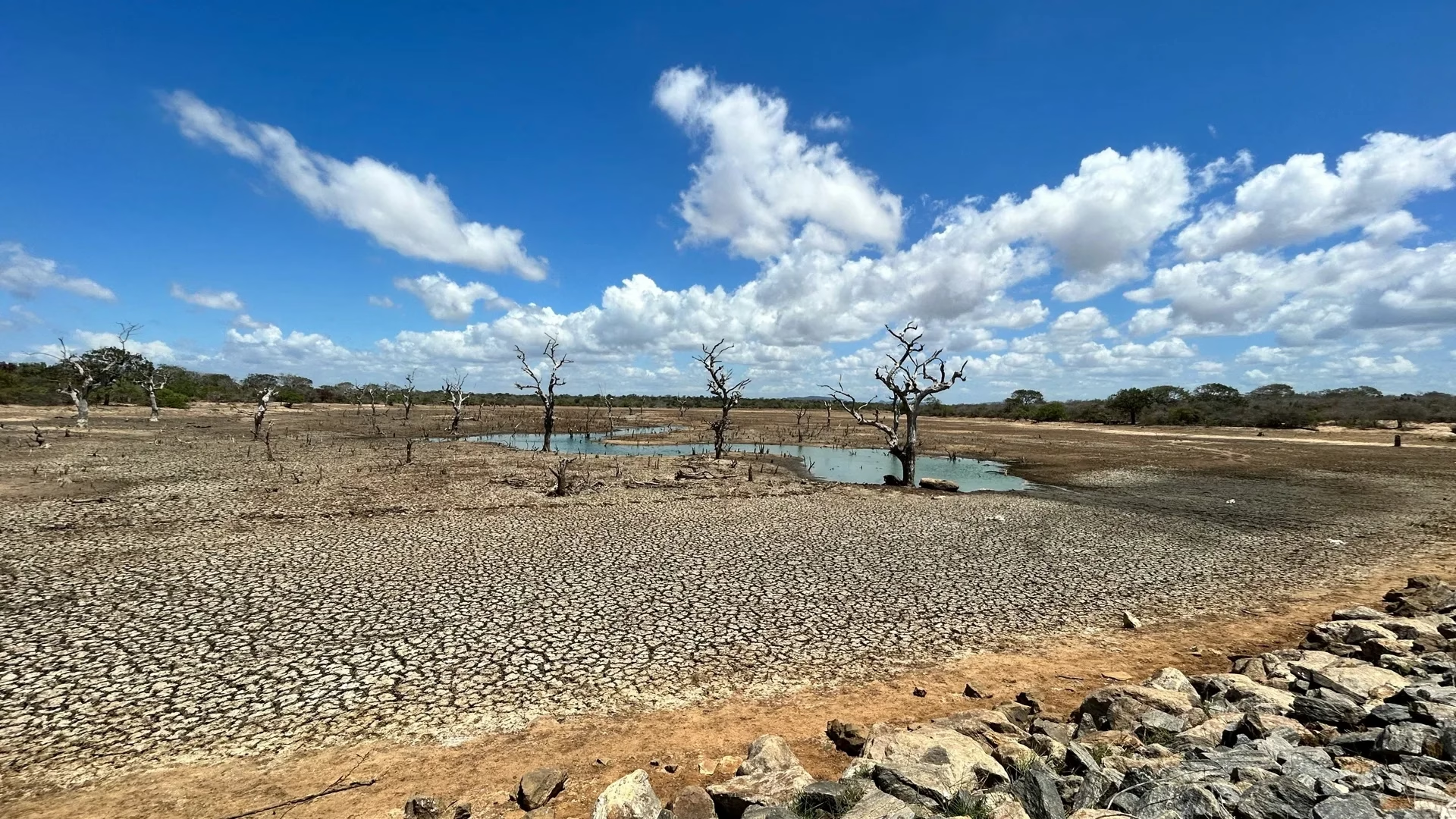
    When and how does someone living through climate crisis decide to migrate? This article theorizes climate migration through an ethnographic case study from northeastern Colombia during a period of prolonged drought.

    Results demonstrate that migration decisions in the context of climate crisis are not single events, but part of a sequence of repeated choices to stay or leave. The number of previous decisions to stay shapes the likelihood of migration, alters the severity of climate impacts needed to trigger movement, and leads to different categories of migrants. These decisions are influenced by households’ material and social resources, as well as their subjective experiences of time under climate stress.

    The study also identifies two main types of climate migrants – adaptive migrants and distress migrants – and also highlights individual strategic migrants as a strategy for household immobility.

    Overall, it argues for a sequential model of climate migration that recognizes multiple pathways and outcomes of mobility and immobility.

    Learn more about this study here: https://doi.org/10.1093/socpro/spaf027


    Reference

    Brianna Castro, Becoming a Climate Migrant: Climate Change and Sequential Migration Decision-Making, Social Problems, 2025

  • The Magnitude of Climate Change-Induced Migration: An Overview of Projections and a Case for Attribution

    The Magnitude of Climate Change-Induced Migration: An Overview of Projections and a Case for Attribution

    While it has been vastly proved that weather and climate affect migration, few studies have attempted to project future impacts or attribute past migration patterns to climate change.

    In light of this, in this paper the existing projections of climate change impacts on human migration are reviewed.

    A comparison reveals that projections for international migration from African countries differ by up to two orders of magnitude, while for internal migration even the direction of change is uncertain. None of the existing models adequately explain historical migration trends, limiting confidence in their forecasts.

    The authors then discuss two modeling approaches: econometric models, which identify marginal climate effects but are limited for long-term projections, and total migration models, which can capture complex dynamics but are difficult to constrain.

    In the end, they suggest that future improvements may come from better understanding nonlinear responses to increasingly extreme climate conditions.

    Learn more about this paper here: https://doi.org/10.3389/fclim.2025.1570995


    Reference

    Schewe, J., & Beyer, R. (2025). The magnitude of climate change-induced migration: An overview of projections and a case for attribution. Frontiers in Climate, Volume 7

  • The Nexus Between Migration and Environmental Degradation Based on Fundamental Climate Variables and Extreme Climate Indices for the MENA Domain

    The Nexus Between Migration and Environmental Degradation Based on Fundamental Climate Variables and Extreme Climate Indices for the MENA Domain

    According to the authors of this study, environmental migration has recently become the primary source of population growth in the Middle East and North Africa, as environmental degradation from extreme events has created the environmental refugee concept with a variety of manners affecting lives.

    In line with this, they propose to investigate how environmental degradation and climate extremes influence migration in the MENA region, using a hybrid approach that combines regional climate modeling (RegCM4.4) with statistical analysis (ordered logit). The analysis covers 65 countries and projects impacts for the periods 2021–2050 and 2051–2080.

    The study assesses how key climate variables – maximum and minimum temperatures and precipitation – along with indicators such as hot days, tropical nights, and dry days, affect net migration rates.

    Findings show that minimum temperatures are projected to increase in all major cities, while precipitation is expected to decline in mid-latitude and Mediterranean regions.

    Statistical results indicate a positive relationship between rising minimum temperatures and net migration, and a negative relationship between precipitation and migration. These trends suggest that worsening heat and water scarcity may encourage migration toward cooler regions.

    Learn more about this study here: https://doi.org/10.1016/j.cliser.2025.100564


    Reference

    An, N., Demiralay, Z., Ucal, M., & Kurnaz, M. L. (2025). The nexus between migration and environmental degradation based on fundamental climate variables and extreme climate indices for the MENA domain. Climate Services, 38

  • Unveiling the Interrelations Between Migration, Climate Change, and Energy Transitions in the Context of Socioeconomic Disparities

    Unveiling the Interrelations Between Migration, Climate Change, and Energy Transitions in the Context of Socioeconomic Disparities

    The interplay between migration, climate change, energy transitions, and socioeconomic inequality are examined in this paper, highlighting their influence on regional resilience and sustainable development.

    Through an analysis of existing literature, it investigates how migration is shaped by environmental stress, energy challenges, and economic inequalities, emphasizing the dual role of migration as both a response to and a driver of climate change.

    Additionally, it analyzes the relationship between energy systems and migration, focusing on how energy access, transitions, and sustainability efforts influence socioeconomic conditions, particularly in vulnerable regions. Key gaps are also identified in the literature, especially concerning the social and economic impacts of these interconnected processes.

    Results suggest that energy transitions can either reduce or intensify regional inequalities and shape resilience to climate-induced migration.

    The authors conclude by advocating for a more integrated policy and research agenda that links climate migration, energy security, and socioeconomic equity.

    Learn more about this paper here: https://doi.org/10.3390/en18071625


    Reference

    Łukaniszyn-Domaszewska, K., Mazur-Włodarczyk, K., & Łukaniszyn, M. (2025). Unveiling the Interrelations Between Migration, Climate Change, and Energy Transitions in the Context of Socioeconomic Disparities. Energies, 18(7), 1625

  • The Impact of Climate Change on Forced Migration in the Sahel: Human RightsPerspective (Nigeria as a Case Study)

    The Impact of Climate Change on Forced Migration in the Sahel: Human RightsPerspective (Nigeria as a Case Study)

    Noticing how climate change casts a shadow on Nigeria’s Sahel region, driving environmental degradation, disrupting livelihoods, and displacing communities, with grave consequences, leaving the most vulnerable in the society square up against human rights abuses in their search to escape their environmental misfortune, the authors saw imperative to study the phenomena.

    This narrative review examines the human rights dimensions of climate change–induced migration in Nigeria’s Sahel region, where environmental degradation, livelihood disruption, and displacement have intensified. Anchored in environmental migration theory, a human rights–based approach, intersectionality theory, and governance and policy theory, it explores the drivers, impacts, and potential solutions to this complex issue.

    Droughts, desertification, and erratic rainfall were identified as major environmental factors forcing communities to migrate. Climate change is shown to severely affect livelihoods and food security, raising serious human rights concerns related to access to food, water, health, and education, particularly for vulnerable groups.

    Study results emphasize the need for a comprehensive response that combines climate mitigation and adaptation, stronger legal protections for climate migrants, humanitarian assistance, and investment in sustainable development, and it is concluded that improved collaboration and policy action among stakeholders are essential to address root causes, protect human rights, and ensure that equity and inclusion guide all interventions.

    Learn more about this study here: https://doi.org/10.3968/13313


    Reference

    Nenger, Jerome A., Nancy U. Odimegwu and Casmir N. Nwankwo (2024), “The Impact of Climate Change on Forced Migration in the Sahel: Human Rights
    Perspective (Nigeria as a case study)”, Canadian Social Science
    Vol. 20, No. 1, 2024, pp. 23-31

  • Preparing for Climate Migration and Integration: A Policy and Research Agenda

    Preparing for Climate Migration and Integration: A Policy and Research Agenda

    Recent research on climate migration is reviewed in this paper, including projections of future migrant numbers, while introducing a typology that distinguishes strategic migrants, disaster migrants, managed relocation, and trapped populations.

    Drawing on migration theory and research on immigrant and refugee integration, the author proposes that wealthy countries allocate additional visas to poorer countries affected by climate change, partly as a form of climate justice.

    These visas could enable strategic migrants to establish social networks that facilitate further migration and eventually support disaster migrants and relocated communities through co-ethnic relations.

    The author also draws on refugee studies to identify key questions about how best to integrate disaster migrants in the future.

    Additionally, the growing link between climate denialism and anti-immigrant sentiment within right-wing movements is examined.
    It is argued that planning for the successful integration of climate migrants is essential, not only for humanitarian reasons but also to maintain the social trust needed for effective climate mitigation.

    Learn more about this paper here: https://doi.org/10.1080/1369183X.2024.2438449


    Reference

    Waters, M. C. (2025). Preparing for climate migration and integration: a policy and research agenda. Journal of Ethnic and Migration Studies, 51(1), 4–23

  • Remembering Colonialism and Combating Hate Speech

    Remembering Colonialism and Combating Hate Speech

    Proposal: Remembering Colonialism at Schools: Acknowledging the European Past to Combat Hate Speech

    Implementation: 2025 to 2026

    Call: CERV-2024-CITIZENS-REM – European Remembrance – 2024

    Type of Action: CERV-LS – CERV Lump Sum Grants

    Proposed Budget: 214 070,00€

    Keywords: Decolonization, Historical memory, education, hate speech, remembrance

    Objective: The goal of the project is to study remember and educate about the European colonial past to combat current discourses of hate speech. Overall, this goal is twofold: on the one hand, it focuses on research-associated activities whereas, on the other hand, highlights the importance of implementing educational programs and promoting active participation of stakeholders and the target groups. 

    The project will maintain a gender perspective, both to ensure parity in the project participation and to understand how the colonial past has had different consequences on people depending on their gender. The project will develop a methodology based on non-formal education to remember European colonial experiences in schools in Spain, Portugal, Belgium and The Netherlands, directed to students of secondary education, teachers and future teachers. 

    This project will contribute to the EU Anti-Racism Strategy 2020-2025 as the theory of change at the basis, and implies that finding new ways of remembering and educating about a history of violations that took place during colonial rule allows societies to become better equipped to respond to current discourses of hate speech, as well as better integrate migrant communities and marginalized minority groups that are often victims of discrimination. 

    Altogether, by intervening in the education sector, the project is to deliver short-term impacts such as raising awareness of how colonialism has shaped European history and identity and how its victims are still negatively affected, especially women, besides giving tools to teachers to adequately incorporate colonialism in history teaching. Finally, long-term impacts include raising a more conscious and tolerant youth that understands the basis of today’s European states as rooted in the colonial period and contributing to a more tolerant society.

    Partners:

    • Fundacio Blanquerna
    • Young Educators – European Network
    • Euroclio-De Europese Vereniging Voor Geschiedenis Onderwijsgevenden
    • Associació Catesco/Catalonia For Education, Science And Culture Organization
    • Ahead – Associació D’educadors En Drets Humans
    • University Of Victoria
    • Studio Globo
  • Extending Reality to Increase Impact

    Extending Reality to Increase Impact

    Proposal:  Extending Reality to Increase European Cultural and Creative Industries’ Visibility, Impact, and Success

    Implementation: 2025 to 2029

    Call:  HORIZON-CL2-2024-HERITAGE-01 – Research and innovation on cultural heritage and CCIs – 2024

    Type of Action: HORIZON-IA – HORIZON Innovation Actions

    Proposed Budget: 3 997 777,13€

    Keywords: Social sciences, interdisciplinary, Cultural and Creative Industries, Digital Transformation, Extended Reality (XR), Digital Skills Development, Location-based Games

    Objective: There exists another Europe, one that is invisible unless you are a part of it, and even then, you can see only as far as your connections go. This is the world of European Art and Culture: the world of hidden bookshops, tailors, ateliers and galleries, back-alley concerts and café reading groups, of Indie publishing houses and labels, community contests and art residencies in old cottages, factories, and castles. 

    Many of these enterprises struggle to keep their head above water as digitalisation marches ahead, due to large business conglomerates with extensive web presences, even locals are at times unaware of the rich world of European art and culture that lies at their doorstep. The Project wants to open that door and to make visible, tangible, and interactive the many nodes of creativity that stretch throughout Europe. And will populate the cultural and artistic digital ecosystem of Europe and open it up to the public.

    Partners:

    • Minds & Sparks Gmbh
    • Young Educators – European Network
    • Tampereen Korkeakoulusäätiö Sr
    • Wirtschaftsuniversität Wien
    • Diversitas It Sustavi D.O.O.
    • Universitaet Hamburg
    • Synyo Gmbh
    • Stimmuli For Social Change
    • Lemon Grass Communication Sl
    • Impact Hub Vienna Gmbh
    • Mira Associacio Cultural
    • Suomen Lastenkulttuurikeskusten Liitto Ry Association Of Finnish Children S Cultural Centers
    • Aristotelio Panepistimio Thessalonikis
    • Centre for Cultural Management